Showing posts with label Ardbeg. Show all posts

Sunday, March 1, 2015

Ardbeg Uigeadail Vertical 2004-2014

Lately there has been a lot of online discussions about the pro's and cons of NAS whisky

NAS stands for "No Age Statement". This is simply a catagory of whisky where the bottle doesn't bear any clue of the age of the whisky. There is a lot of NAS whisky out there and the biggest sellers in the world are NAS whiskies, Cheap blends, Johnny Walker Red, Jack Daniels, Jim Beam White. It's not a new thing. And due to various labeling and production regulations, we know that Johnny Walker is at least 3 years old and that Jim Bema White is at least 4 years old

But this is not really the whisky people are referring to when discussing NAS whisky. It's usually when NAS whisky is replacing whisky with an age statement. The producers argument for bottling whisky with No Age Statement is that whisky should be bottled when it's ready, not when it passes a more or less random selected age mileage. If you go into a typical warehouse and open two casks of whisky, both distilled at the same, and lets say 8 years old, it's not uncommon to find that one is very good and perfectly ready for bottling and the other is not ready at all and do need more years in the warehouse.

But if the bottle line up of that distillery is that this whisky has to be at least 12 years old, that good cask can't be bottled as part of the standard lineup. It doesn't meet the age requirement yet.

So the producers say: Lets drop the age statement on the bottle and bottle the whisky when it's ready. Let's not be a slave of the age requirement. Let's just bottle the whisky when it's good.

Unfortunately, consumers say, reality is something else. The last few years we have seen a whisky shortage. A whisky shortage is when demand is higher than the supply. Whisky is popular. There is a whisky shortage both for single malts and bourbons. There is a few shortcuts the producers can take to meet the demand. One is to bottle at a lower alcohol strength. If you add more water to your whisky, you can produce more bottles. Another one is to skip the age statement. By bottling a whisky at a younger age, you shorten the production time. This will initially give you quite a larger volume to pick casks from, but also as the bottling catch up with the now extended stock there will be a slight increase in production from the fact that whisky in the cask looses 2% volume on average every year. So if you bottle whisky at 10 years instead of 12 you will eventually, apart from a shorter production time, also have around 4% more whisky to put in bottles.

Most entusiasts are not very happy with this trend. Myself included. When you go into a duty free whisky store you see a lot of NAS 40% whisky. For Scotland particular, younger whisky has a higher alcohol percent than older whisky when resting in the cask. As whisky matures in a cask the alcohol percentage slowly goes down. In short this means that if you buy a 6 year old whisky at 40% and a 15 year old whisky at 40% you can be pretty sure that more water has been added to the 6yo to get it down to 40% than what was needed for diluting the 15yo casks. So young 40% whisky is really the last kind of whisky you wan't to buy. It contains a lot of water

I like age statement for standard products. It gives a tiny little guarentee of what goes into the bottle.

Some of these you can drink when pregnant, some not


So we set up this blind tasting of one of the most popular NAS bottlings out there. Ardbeg Uigeadail.

It's Ardbeg. It's bottles at 54.2%. It, unlike most other Ardbegs, have a heavy sherry part in the vatting. It's the essential peat and sherry combo in many peoples opinion. Peat and sherry doesn't always mix very well, but this bottling has been popular for over a decade now.

We managed to gather 6 bottlings. 5 of them was the with old bottlecodes

L4 315, L6 109, L7 325, L9 327, L10 032

L7 325 simply means it was bottled on the 325th day of 2007

The 6th bottling was a very new bottling from the new bottle facility, and it had a bottle code like this L59501 29072014. I interpret this as bottled 29th July 2014

So we had a selection of Uigedails from 2004 to 2014. The earliest bottling of Uigedail I know of, was bottled in 2003, L3 282 so I think we covered the era of Uigeadail quite well.

So how did we set this up?. We tried to set this up as a blind tasting. And we set two aims for ourselves.

1. Could we identify the L7 325, which apperently should be a rather good one. Check out that link to The Ardbeg Project. A couple of years ago I tasted this at a another vertical and back then I picked it out as outstanding compared to other batches. Locating a bottle of this at one of my friends was what triggered organising this tasting.

2. Could we identify the L4315. Of the other 5 batches 3 was opened on the day, 1 a couple of days before and the 5th 3 weeks prior. The L4315 had been open for years. Untouched for years and with just around a 10cl dreg in the bottle we wondered if this could affected the whisky enough to be pinpointed amongst 5 others recently opened bottles

Fast answers: We couldn't identify the L4 315. It was easy to identify the L7 325. The cork broke and even though I tried to clean the whisky from small bits of corks it was identfiied by one of the participants.

I was pouring the whiskies and the other 3 shuffling them, I also knew which was the L7 325. I didn't need the cork bits to reveal that. It was considerable darker than the other 5.
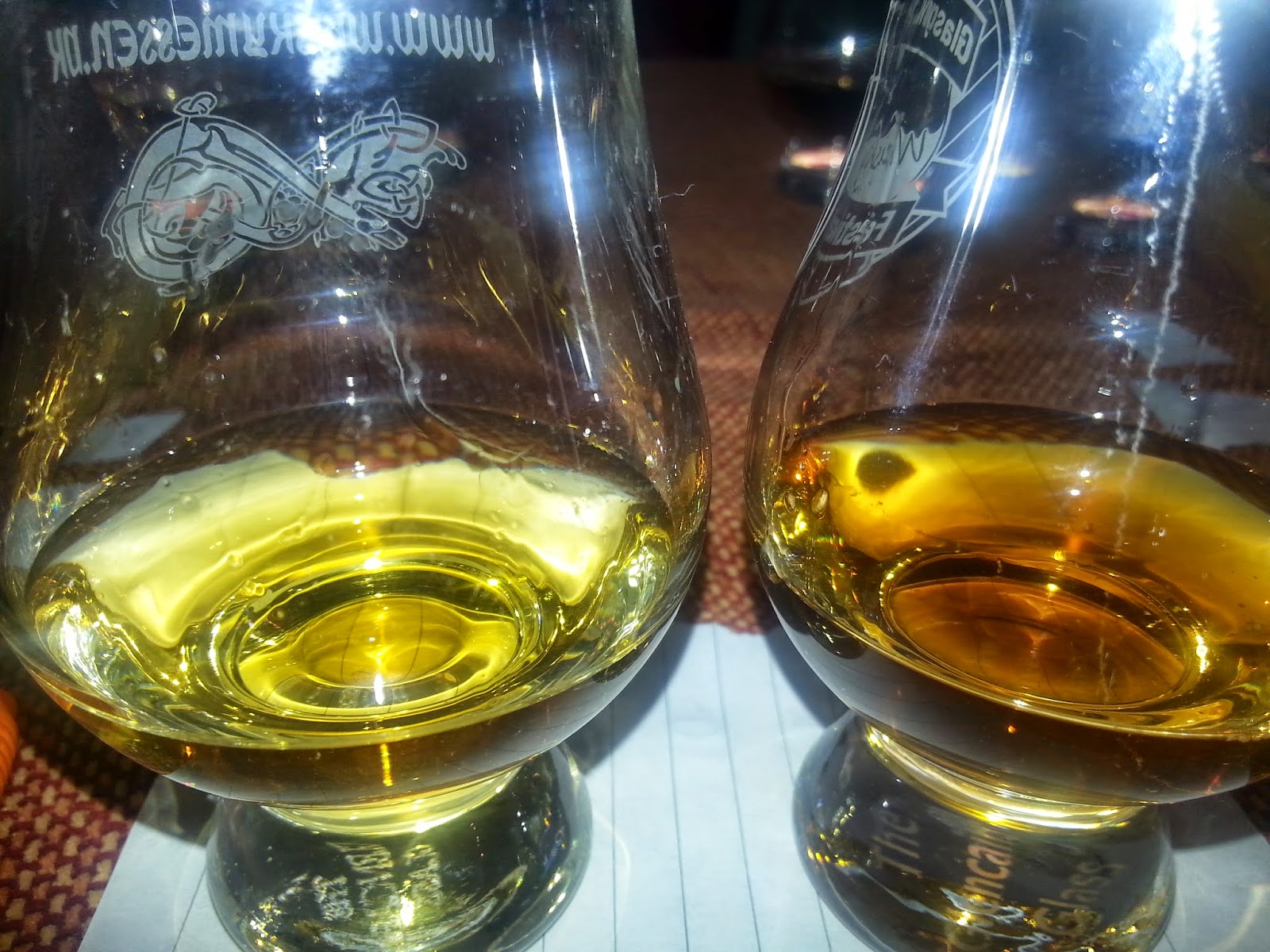
2014 versus L7325

Here are my verdicts of the 6 bottlings. They were tasted blind. I knew which was L7325 though

L4 315.
Slight sourness on the nose. Parmesan and babypuke is what people often refer to when we meet this in whisky. It was also sulphured. The sulphurness carried over into the palate. As I am extra sensitive to sulphur, it meant I rated this lowest. This is a good example of a whisky that is not bad, but just get a low rating from me, cause I don't like it and can't cope with sulphur. Score 78

L6109
This had a very faint sourness as well on the nose. But the palate was fine. One of the particiapants really disliked this one, while us other three liked it. The nose couldn't drag it down a lot so Score 86

L7 325
We knew what is was. But it was easy no brainer to pick it out. A lot darker. With a hint of old sherried Ardbeg. A great whisky. My guess is that some 70's Ardbeg went into this one  Score 90

L9327
My favourite outside the L7 325. Just as a good Uigeadail should be with no flaws Score 87
L10032
Very well balanced and with substantial less alcohol burn than the other 5. I thought this was one that had been opened for years. Score 86½

L5950129072014
Not very good. The nose was grainy, new boiled pasta and newmakeish. Not a havy sherry influence either. What a dissapoint. The L4315 got a low rating cause I didn't like it. This got a low rating cause it was bad whisky. Score 79. In hindsight today I feel I should have score it even lower

The whisky was served in this order: 2004-2014-2010-2007-2006-2009

When the whiskies were revealed even the atheists amongst us were paraying "Let #2 not be my bottle"

I couldn't help thinking that the reason the 2014 bottling was so bad was becasue Ardbeg Uigeadail is a NAS whisky. For this particular batch they seem to have used a lot younger whisky. I don't know for sure. Maybe the casks used were exactly the same age as the casks used for other ones. Maybe the whisky was just not very good. We don't know. But if I bought this bottle I would complain to the shop, and if I had this bottle in my shop I would complain to my importer

No matter if we averagied our scores or averaged our individual rankings we ended up ranking the 6 Uigeadails like this

2007-2009-2010-2006-2004-2014

3 out 4 had the L7325 as favourite. 4th participant had the L9 327 as favourite with L7 325 on the 2nd place.


If you wan't to read more about Ardbeg batches and Ardbeg bottle codes, I recommend The Ardbeg Project




Wednesday, October 9, 2013

7 whiskies to taste before you die

A lot of the lists I see floating around the internet, books etc., "best this", "try that"," read now", "die later" seems quite random and made by people who just shouldn't have made a list. My problem is usually not what is NOT on the list, but what's on it!

I decided to make some lists for others to disagree with. Here's the first!

7 whiskies to try before you die
and a few extra recommendations

This is the real thing. You ain't gonna turn around in your grave if you miss out on Jim Beam Black whatever Ian Buxton says

The seven whiskies is more a catagory or groups of bottlings, than a specific bottling. 3 specific great whiskies to search for is mentioned below though.


1. Ardbeg from the 70's
Around the turn of the millenium there was quite a big stock of old Ardbeg lying in their warehouse. This was before Ardbeg was the talk of the town and before Ardbeg was one of the most popular malt whiskies out there. So a lot of quite old Ardbeg was bottled, a lot cheaper than today. The best were those distilled in the 70's, early 70's particulary.

Here's a few legendary bottlings: Lord of the Isles, Ardbeg Provenance, Old Malt Cask did a range of bottlings, like the Ardbeggeddon for the PLOWED society and the distillery itself did a range of single casks.

2. Brora
Short version: Clynelish distillery was "copied" in the late 60s and the owners renamed the original version Brora, and kept the name Clynelish for the new modern distillery next door. Brora, the original Clynelish, was closed in 1983.

In the early 70's, while Caol Ila was being modernised by DCL (now Diageo), they used Brora to produce some peated whisky for extra supply. While Clynelish and Brora are similar, but still different whiskies, they differ a lot in this period, when one was peated and the other not. Personally I found Brora around 1972 to be the most peated. Brorageddon from the PLOWED society and OB 30yo 2002 are my two favourites, but I sure wished I bought more of this, but who doesn't ?

3. Bowmore from 60's
Bowmore from the 60's is legendary. It's not just the super-expensive Black Bowmore, White Bowmore and Gold Bowmore, but also Bowmore like the 1964-1979 Bicentenary:  http://www.whiskybase.com/whiskies.php?merkid=4&whiskyid=7299

Most people, but not all, agree that something went wrong with Bowmore in the late 70's up to mid 90s, particular in the 80s, but they seem to be back on the very right track now. I wonder if they dare to make a bottling called "Phoenix" one day!

4. Caperdonich 1972
Duncan Taylor was essentially based on a huge stock of "forgotten" casks. Amongst them were quite a large amount of Caperdonich casks filled in 1972. These were bottled more or less one by one over a period of around a decade. From being a distillery that was regarded as a nothing, Caperdonich became one of the recent legends in the world of whisky. It's not just Caperdonich 72 that is great whisky, aged Caperdonich in general is marvelous. There just happened to be a lot more from 72 around than other vintages. Caperdonich was mothballed in 2002 and is demolished today.


5. Stitzel-Weller
Stitzel-Weller was closed in 92 and is arguably the most legenday bourbon distillery. The blame or cause for this is probably the bottles released as Pappy van Winkle. Pappy van Winkle is a brand, and as the stock of old Stitzel-Weller is dissappearing the whiskey is replaced by similar aged whiskey from other distilleries. It looks like there is no problem keeping the quality up, basically telling us that the recipe combined with carefully cherrypicked barrels is the key, not the distillery itself. But the legacy is there, and it is there for a reason. Look out for older bottlings of Pappy van Winkle 15 and 20 and Jefferson Presidential Select labeled as Stitzel-Weller. The original brand from Stitzel-Weller was Old Fitzgerald (now owned by Heaven Hill) I hope I one day will be able to try bottlings like Very Old Fitzgerald, Very Xtra Old Fitzgerald and Very Very Old Fitzgerald from Stitzel-Weller. And hey, rumours says Stitzel-Weller will reopen!


6. A. H. Hirsch
A. H. Hirsch is a range of bottlings from a distillery in Pennsylvania, all distilled within the same week in 1974 and most of it dumped from the barrels in 1990 as 16yo. I recommend that you read Chuck Cowdery's book "The best bourbon you'll never taste" for further info.

7. Rosebank
To me Rosebank is THE legendary lowlander. Closed in the 90's. Triple or 2½ times distilled (or both, people are arguing about this). When people are talking about the Lowland catagory and how it's supposed to taste, they basically talk about how Rosebank tastes. Or did taste. The rest of the Lowland is more or less as different as the rest of Scotland without being peated.

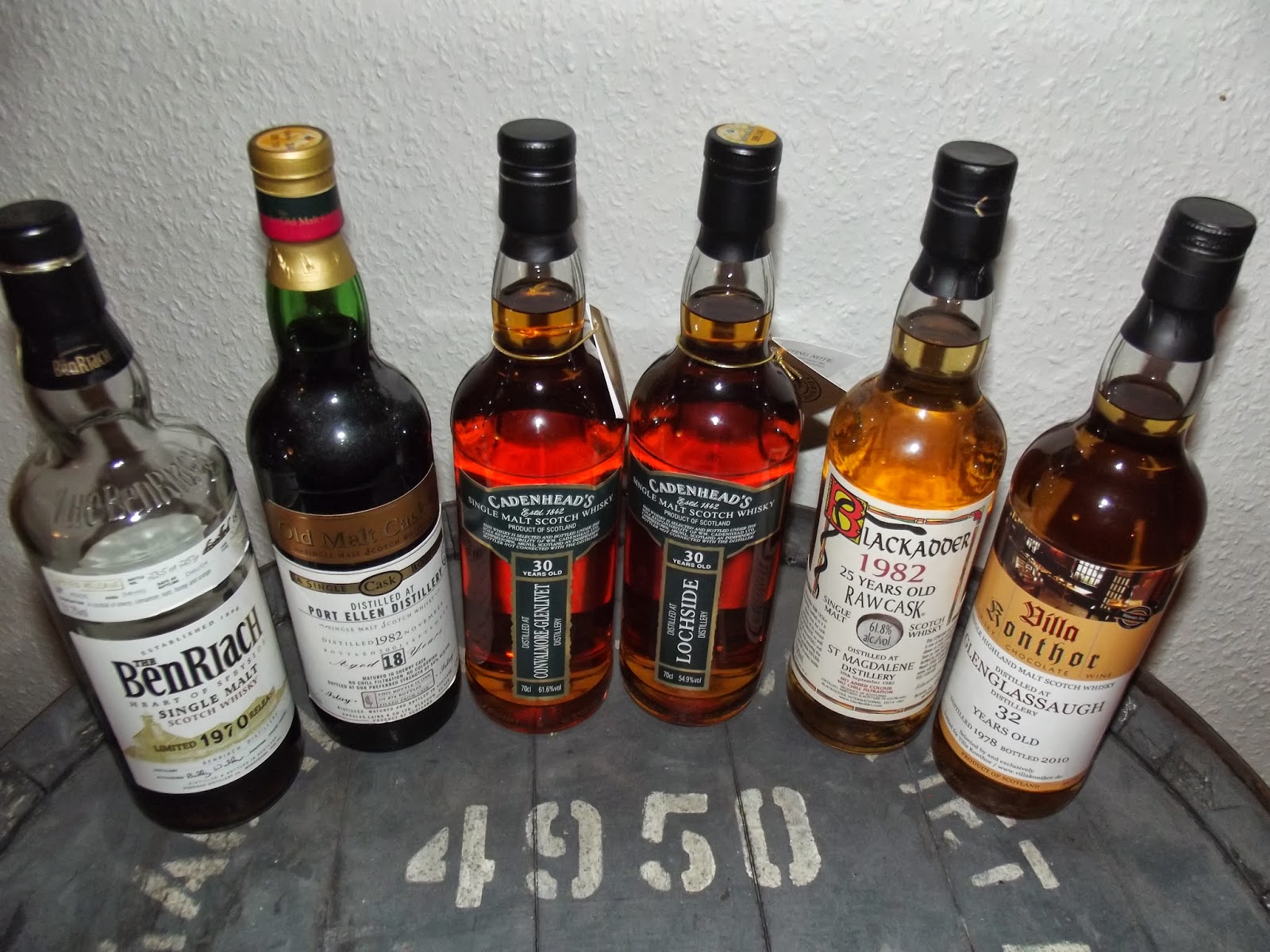
If you think Old Benriach, Port Ellen, Convalmore, Lochside, St. Magdelene and Old Glenglassaugh should have been on the list, I can't really disagree

Should this rare rye have been on the list. I think so

You don't have to go way back in time to find spectular AND affordable whisky.
SMWS 35.71 "like a hug from your mom", released 2012

Benromach 55yo.
I wish I had a bottle
(Photo stolen from TWE)

Martin Mills. Best bourbon I ever tasted. Who wants to sell me a bottle ?

Next list will be: Things to do in Edinburgh, especially  if you like whisky!


Saturday, February 9, 2013

The six PLOWED bottlings

Here is a list of the 6 PLOWED bottlings, the labels has been retrieved from the COLA site.


Bottled in 1999. Fantastic old Springbank. This is a favourite PLOWED bottling by a considerate fragment of the group.

Another Classic. Early 70's Ardbeg by Douglas Laing. Say no More. Another favourite. Bottled 2001
Dave Broom and Michael Jackson disagrees HERE 

Brorageddon. The best Brora I have tasted. My favourite of the PLOWED bottlings. It's even a candidate to the best whisky I have ever tasted. 
Bottled 2003. First label to include the slogan "Self-styled whisky connoisseurs" It wasn't meant as a compliment when a Bowmore rep. adressed Bushido, after an enquiry about the tasting notes he had discovered in recent bottlings, which he described as FWP
LAWS reviews it HERE

Port Ellen from 2004. This one divides the group. Some like it (a lot), some don't. I am not a big fan
LAWS like it , HERE 

The last of the Old Malt Cask quartet. A Laphroaig bottled in 2006
Serge reviewed this one and liked it here

The latest addition to the range and the first OB, a 1986 BenRiach bottled in 2009, which again combines peat and sherry. Another bottle that split opinions, seems like it need some time in the glass/bottle

Conclusion? Don't drink with PLOWED if you're pregnant


Sunday, March 18, 2012

Alligator, Black Art, Thor and a Scapa

Last night I had a few drams at the Cockney Pub in Århus. Here's 4 short reviews

1. Higland Park Thor 16yo 52.1%


Nose: Light, fruity, apple-pears, a very plesant nose, but not typical Highland Park
Palate: Dark fruits, light peat, sligth rubber emerges from the initial lighter fruitness
Finish: Medium
A bit unbalanced, the slight rubber puts me off a bit
Norm Dam: "one of those whiskies you can give a lady instead of a cognac"

Rating 81

The two fellows in the bar, said I should have got the Black Art instead, Norm warned me and said it was just another ladies whisky. Let's see

2. Bruichladdich Black Art 21yo 1989 49.7%


Nose: Fruity and delicious
Palate: latex, again some sligt rubber, dried fruits, this whisky seems flat to me in the sense that it has no edges. This tastes like there has been several casks involved. Finishing tends to cut of edges. Very drinkable and balanced, but not really my style
Finish : Longer

Rating 83

3. Ardbeg Alligator 51.2%

Nose : Intrigueing nose, reminds me of Uigeadail actually. The complexity hits me, its clearly we are one step up from the prior whiskies. Peat and wood with a nice vanilla spicyness in the background
Palate: Peat and charcoal(light), This whisky feels round and balanced initially but
Finish : The youth is expressed with a slightly rough an roasted finish

Alligator has been matured on extra charred casks, which are named alligator casks throughout the industry as the charred wood looks like alligator skin. This extra charring is clearly present in this whisky which has a note of burned wood, most clearly present in the finish

Rating 86


4. Scapa McKillops Choice 1989 54.4%  14yo


I wasn't really gonna get a fourth, what can possible follow a heavily peated Ardbeg ?. But then I spotted this on the shelf which was whisky of the week. So I decided to relax with this, and I have to admit I wasn't that analytical drinking this. The young guy next to me, dressed up as a 2 meter tall green irish leprechaun, was going on about this Grand Marnier finished whisky he really liked but couldn't remember the name of. Maybe it was the Black Art :-).


Often Scapa is a somewhat anonymous dram, but this was rather pleasant with signs of maturing on a good cask. It was a combo of lighness and wood spicyness which I think was really well balanced and I really enjoyed this final dram before joining the didley-dees with a pint of Guiness (and a Jaipur..)

Rating 85


Friday, August 26, 2011

Ardbeg Glenrothes 9 yo


A couple of years ago Douglas Laing released some young, vatted malts with whisky from two distilleries, one cask from each. Let's taste one of these bottlings.
Ardbeg & Glenrothes Double Barrel, 9 yo, Douglas Laing, 46%
Nose: Flint stones and salt come rushing out followed by fruity notes and tar. This is young and spirity. We're not talking a lot of nuancens here but it does hold your nostrils in a firm grip. After a few minutes a sweet rubbery note appears which is frankly a bit too much for this humble taster.
Taste: Pears and tar rumble their way round the mouth. Other fruits try to mix in but have to do with a background seat as the young alcohol dominates. The finish is peaty with asphalt and liquorice.
I must say I prefer a young Ardbeg on it's own or a Glenrothes ditto to this release which is by no means bad whisky. It's just not very entertaining.
Rating: 79

Saturday, July 16, 2011

5 Peated Whiskies

Well, time for a flight again, it has been a long time. I had a look through my open bottles and found 11 I haven't blogreviewed before, and as there were 5 peated amongst, I decided to have a go at them.

I love the smell of peat in the morning.

The Agenda

Being a long time peated whisky drinker, I have found that I sometimes, or very easy get immune to peat, so if I say a whisky isn't too peaty, don't trust me! (necessarily)


1. The Hakushu Heavily Peated 48%

A Japanese distillery with a range of different stills. This makes them capable of producing different styles. Another expansion of possibilities is to use peated malt.


Nose : The peat isn't dominating, but it's present, fruity, like the fruitiness of apples and pears.

Palate : Very drinkable, easy going and delicious, also somewhat subtle in its expression, making me think of older Islay's more than the younger smack-in-your-face ones. The peat emerges into a spicy vanilla lemony finish, which is very delicate. 

Finish : Short/medium with the sugarly lemon being dominant

Comment : I wouldn't have named it Heavily Peated, it's much too delicate for that description. This is a NAS whisky, but if i'ts young it seems like the hotter climate of Japan has matured it very well. I am glad I chose this as the first whisky of the day, it would most likely not benefit from following other whiskies, peated or not.

Rating 85

2. Bruichladdich Mòine Mhòr 3D 2nd Edition 50%

This is a vatting of different styles and ages of whisky distilled at Bruichladdich supposedly from three different decades and three different peating levels


Nose : Some peat, and some solvent like immaturity is just present if you look hard enough

Palate : Feels warm in the mouth, with a lot of wood, spice and lemon under the peat.

Finish : Medium

Comment : This has got some punch, not due to the peat alone but also from the youthness of the whisky, or some of the whisky in the vat. This is really well vatted together and an enjoyable dram

Rating 83

3. Lagavulin "Available only at the distillery" bottled 2010 52.5%


Nose : Sweet, spicy, fruity, dark fruits

Palate : Great full bodied mouthfeel and texture. The sweet PX  mixes real well with the peat, but the sherry influence is a lot lot less than in the DE Lagavulins. Peat and vanilla in the end

Finish : Long and very spicy

Comment : This has got some leftover casks for the 91 DE batch in it. PX finished. Bottling Lagavulin at full strength is a very clever idea!

Rating 88

Finally a couple of Ardbegs bottled in 2010


4. Ardbeg 1994 Cadenhead 16yo 55.6%

Nose : A lot of imminent immaturity on the nose, acid like. Not the best nose

Palate : lemon, peat, classic Ardbeg'ish, but the cask didn't have the strongest influence, seems younger than 16- After the nose that did put me off the nice peat-lemon combo is welcoming. The acidity is still here

Finish : Medium

Rating 78

5. Ardbeg 1994 Cadenhead 16yo 57.0%

Quite similar to the above

Nose: Slight acidic as well, but less than the above

Palate : More wood, texture and body, lemon again and a hotter immideate finish 

Finish : Medium-long with a hint of coconut

Rating 80

Comment : Mark from Cadenheads told me to get the Laphroaigs instead as he thought they were better. But I wasn't going to Laphroaigeddon. I should learn to listen to advice from wise people


Monday, April 18, 2011

Whiskypranks and blind tastings

The label of a whisky bottle has an influence on how I and other whiskyfans appreciate a whisky

No doubt about it. If people tells me otherwise I don't believe them :-)

One good example is how Ashok from Amrut presented/introduced his range to Denmark. He said that if he just served Amrut to others, they would automatically think it couldn't be very good as it comes from India

Instead he chose to battle 4 of his whiskies against 4 from Scotland. Blind. Quite an educating experience. It showed out I had Amrut as clear winner in 3 of the battles. The 4th was a draw.

The 4 sets were :

Amrut 46% versus Glenlivet 12
Amrut Fusion versus Highland Park 12
Amrut Cask Strength versus Glenfarclas 105 (my draw)
Amrut Peated 46% versus Bowmore Legend

Surprisingly my most clear winner was Fusion against a whisky that quite often is declared the best in the world. There you go. In the room of 33 tasters, Amrut won the all catagories except the one I had as a draw which was lost by 1 vote.  I thought the 105 and the cask strength Amrut was very alike and Ashok said he had trouble telling which one he thought was the Amrut of those two :-)

Well this was my most educating experience. The most impressive I have seen was done by the Ardbeg expert, fellow PLOWED member and Malt Maniac Tim Puett, the man behind www.ardbegproject.com !

We selected 4 Ardbeg 10's and wrote down the bottle codes (batch numbers!) Here is the set :


L1 045 - L5 290 - L7 143 - L7 325


We had all the codes written down and Tim nailed them all....impressive (I didn't guess anything..)


I often make some pranks with whiskies. One of the better ones was pouring a cheap blend into an empty bottle of a standard scottish single malt and then serve it. 


Once I went into my kitchen, melted some sugar and divided a bottle in two. Then I coloured one of the parts. After a testing session I send round these 2 blind samples and the reactions and guesses were very different. After the truth was revealed some of the guests tried to distuingish between the two blindfolded and they said they couldn't really tell the difference..


This told me that the colour of a whisky affects how it's received with a huge impact


Last year I was on a holiday on Crete. Local customs is that you get served a Raki after a dinner. This is like a cheap Grappa. One day we visited an olive oil farm http://www.paraschakis.gr/index_en.html


Old Raki Still

They had a Raki which I found a lot more pleasant than the usually stuff I was served before during the holiday. I bought a wee bottle. Last week I served some of this blind at a whisky tasting as first go. People thought it was whisky newmake!

Oh, I gotta show you the view from that olive oil farm :

Paps of Crete!


After the Raki  I served the Mekong Whisky. This is never received positive, but I noted that when I served this blind the negativeness was less!

I observed the same pattern when a very very good whisky is served blind. The positiveness is much higher when accompanied by a label.

Todays review


1. Mekong Whisky

The nose is sligthly chemical , a bit like a weak solvent, not really unplesant, but no way whisky like..well rumours said this is made on 95% molasses and 5% rice with added spices, so this is really not a whisky. I have a hard time reading the label so the details is up to you to read yourself. The taste is like a very mild bitter, highly diluted becherovka comes into mind. A weak woody finish with a not-very-nice sweet touch. Nothing exciting about this, but I wouldn't describe it as flawed either. Greatest thing about this is the short finish.

It will not get a very high rating thou

Rating 55


Saturday, December 4, 2010

My favourite Whisky videos from Youtube

I like these 4 videos from You Tube

Whisky is not for Everyone by Dr. Whisky


Ralfy made a lot of good vlog's, this is my favourite :

Ralfy reviewing Port Askaig 17yo
see more of his vlogs at http://www.ralfy.com/


I also like this one, it's Tim Puett (http://ardbegproject.com/) opening his Lord of the Isles

Chief Article pops a LOTI, starrring Tim, Tom and Mikey


And finally The Man Who Walked Around The World starring Robert Carlyle :


Sunday, July 11, 2010

A flight of 5 peated malts

1. Ardbeg SuperNova 2010 60.1% (L10 070)
 Anoraks can discuss peat ppm values forever, something that started around when Bruichladdich decided to got all-inn with peat in barleys and produced Octomore (80ppm) and later Octomore with even more peat. Some claims that there is a theoretical limit below these values for peat content.
 Here's a few things about ppm, peat and whisky :
ppm stands for parts per million and is measure to describe small contents of whatever... When it comes to peat its the phenol contents, as phenols gives malt whisky its peated/smoky taste.
 ppm values given are for the content in the barley. The ppm value actually diminish in distillation, so even though Ardbeg uses the most peated barley for their standard produce, the newmake of Laphroaig has a higher ppm value than the ppm value for Ardbeg new make. Phenols must be breaking down when a whisky mature, as the ppm value goes down as whisky mature in the cask as well. This is no exact science and sometimes you get old whisky that are surprisingly peaty
The ppm value for this Ardbeg supernova is given on the bottle as 100ppm, opposed to the standard 50-60ppm for Ardbeg. I am not sure how much difference this will give in the newmake, but the fact that this is younger than the Ardbeg 10 will add to the relative peat difference as will the fact that this is cask strength
Now back to the whisky : The first thing I note is that this doesnt actually seem to be that peaty. I don't get the chok-effect that Ballechin gave me (heavily peated Edradour)
This doesn't have the sweetness I got in SN2009, I find it a lot more one-dimensional (actually described as a deeper, earthier character on the bottle compared to SN2009, In which I agree)
My comments : Dry, peaty, newmake - I prefer the SN2009
Rating 85


2. Ardbeg Rollercoaster 57.3 (L9 344)
I've been a member of the Ardbeg committee since around it started (I think I got number 389). In the early days I had pleasure of acquiring almost all of their releases, but the bottlings out the last years hasn't been the same (everything was much better in the good ole' days). Legends like the 23yo-ish sherry casked Ardbegs, Kildalton, 21yo, early 70's single casks etc. are now in my collection of empty ardbeg bottles. Recent bottlings has also been a heavy lift in prices unfortunately. Guess we shoulkd't have told everybody how good Ardbeg is 10 years ago ?.
The Rollercoaster is a bottling to celebrate the 10th year anniversary of the Ardbeg Committee. Its a vatting of casks distilled every year from 1997 to 2006, making this a 3yo technically. Young Islays has become a catagory of its own the last decade. It's very popular, the world is full of peatjunkies. So offcourse every distillery and every IB is having something in this catagory.
Ardbeg probably had the most, but this is more to the fact they only distilled regularely since 1997 so their main stock has been young whisky
This is one of the best young Islays I had, far better than any of the AVY, VYA, Still Young, Almost There etc., seems like they kept their best casks!
My comments : citrus, peat, complex (I need that T-shirt), the different cask vintages in here works together like a rollercoaster
Rating 85


Note : SN2010 is 80£, Rollercoaster 50£. These are high prices, a lot of people refuses to pay 50£ for a "3yo", but I think the whisky got the quality to justify this is bit. I find it lot better than the SN so in the Ardbeg catagory it's good quality for money!

3. Bruichladdich : Port Charlotte Cuairt Beatha PC6 61.6%
Finished in Madeira Casks
First impression is that this is a slight sourness, which lessens as you take the first sips. Still very detectable in the nose unfortunately. This seems quite fierce, and I do admit I often have problems with finishes. This is no exception. I don't find that the peat and the madeira works together here.
Rating 65


4. Brora - Old Malt Cask cask 2294 50% 23yo Nov. 1982
First I'd like to point out that if you look for peated in a Brora, go for something distilled in the early-mid 70's. But the lack of peat in this won't let me take it of todays vertical. This is from a sherry cask, but it isn't overpowering. But the nose and palate doesn't lie. It's woody in the good sweet way I often see, and absolute adore, in old Brora's and Clynelish', is it the mix of this and peat that make 70's Brora's outstanding ?. The nose is a delightful sweet spicy mix with a big flowery/honey touch. The palate is sweet, prickly, and sherry-woody
My comments : sweet, sherry, prickly, flowers, spicy
Rating 89


5. Glen Keith 33yo old 1971 Lorne MacKillop D&M Aficionados' Club 43%
Glen Keith is the neighbour of Strathisla in Keith, and has been silent since 1999, functioning today as filling store and technical center. This is a sample of an american bottling I got from plowed-exile Rodger Howard. 
This is surprising me with its peat!, not something you expect from a Glen Keith. I also find citrus in this one. A lot, this is probably one of the most citrus-lemon whiskies I had. Which is good, cause I like that. It reminds me Ardbegs the same age and vintage. The intensity is high so I suspect not much or no water at all has been added to reach the 43 ABV. This is pure joy to me
Rating 89


Edit summer 2011: I am pretty sure the sample bottle was contaminated as when I tasted this directly from the bottle there was no peatyness AT ALL, fact is that I tasted something else and I don't know what and I wonder if Rodger does :-)


Real Rating 82


Monday, March 29, 2010

Ardbeg 17yo OB 40% (bottlecode L0)

Keywords : fruity, earthy, peaty, woody, bitter, water

Balance : Very Good

Finish : Medium-Long, intense


Rating : 85

Ardbeg 10yo OB 46% (bottlecode L0)

Keywords : peaty, medicinal, flowery, citrus

Balance : Very Good

Finish : Medium-Long

Rating : 85


note : test-post