Showing posts with label Pappy van Winkle. Show all posts

Saturday, March 25, 2017

A short guide to Del Maguey for whisky drinkers

Today I am moving into a subject I don't know a lot about. I went to a Del Maguey event organised by the danish importer, Juul's Engros, and tried to learn a bit. The event was a promotion for mainly local cocktail bartenders. It was hosted at the Mikkeller bar in Aarhus, and I managed to get an invitation from the boss of the Mikkeller bar. Drinking a lot of beers sometimes pays off 😈

The Mikkeller Bar has a limited (very) selection of spirits, but there is 2 bottles of Del Maguey on the shelf there, which is about a fifth or sixth of the total selection of spirits. It is a beer bar after all.

I have always been a big fan of the Del Maguey mezcals I have tried.

Del Mageys is one of the top, if not the top bottler of Mezcal.

The line-up


Mezcal is a mexican spirit made from agave . Agave is a plant that looks like a mix of artichokes and cactus. Like the artichoke, it's the heart of the plant that is used.

The best known version of mezcal is tequila, which is often mass produced and not very good. That said, quite a lot of excellent tequilas do exist. Tequila is made from blue agave, while mezcal can be made from any agave. Tequila is sometimes barrel aged, which mezcal (normally) isn't.

After harvesting the agave is roasted in a  small earth pit by hot stones for a period of days, which varies from producer to producer.  Beside some geographical restrictments (which overlap), this is the main difference between tequila and other mezcals. Tequila is often just pressure cooked.

I guess the cooking/roasting breaks down the starch to sugars. The roasting will give mezcal a slight (sometimes more than slight) smoky flavor.

The agave is then milled and fermented, with wild airborne yeast. At this point of production the only other ingredient is added, which is water. After fermentation the mash is distilled. The stilltype can vary, Clay and copper potstills is the normal, and as I understand it, it's a double destillation (normally). Hybrid stills do exist, so single destillation mezcal dom exist and I taste one further down this post. No water is added to Del Maguey after destillation, so the ABV is controlled by running a relative longer tail than compared to normal whiskyproduction.

Del Maguey (maguey means agave) is a range of mezcals produced by small family owned producers in the Oaxaca state in Mexico. This is basically farm distillers. The difference between the different mezcals comes from a range of parameters, here is some of them:

Agave variety
Soil
Altitude
Roasting time
Fermentation time
Still type

At the event I tasted the following:

Chichicapa

Chichicapa had a distinct smoky flavor and would appeal to whisky drinkers who like Ardbeg

Minero

Minero is made on clay potstills and I guess the abscence of copper is why Minero is a bit rougher, sulphury (vegetaby) and has intense flavour. This Mezcal will appeal to whisky drinkers who like Ben Nevis and Glen Scotia. One of the other participants, the cheese maker from Arla Unika, bought a bottle of this to use as ingredient in a cheese. Because it was the most intense mezcal we had that day. He was right. And it makes sense to choose this as a flavour ingredient

San Luis del Rio - Azul
A lot of sources says Mezcal's isn't made from blue agaves. They are wrong as this is. The Azul is sweeter and nice and will to whisky drinkers who like sweeter highlanders/speysiders. Think Glencadam (I did)

Barril
A dry (but also kind of sweet) mezcal. Earthy, citrusy and smoky. This and the Chicicapa were the two I found most smoky. Chicicapa was a tad bit sweeter. This will appeal to whisky drinkers who like Longrow
 
San Pablo Ameyaltepez
The lighest of the bunch. I found this a bit synthetic tasting, but still nice. I wonder if I thought so, becasue I was told this mezcal was single distilled on a hybrid still 😀
This will appeal to whisky drinkers who like grain whisky.

Pechuga

Pechuga is a rare speciality version of Minero. Pechuga means chicken. The Minero is distilled a third time. 100 liters of Minero is mixed with 100 kilograms mix of wild mountain apples and plums, plantain red bananas and pineapples, almonds and uncooked white rice. In the neck of the still the vapour of the 24 hour destillation will pass through skinless chickenbreast with bones

The result is a spicy and very complex spirit. This will appeal to whisky drinkers who like really old and delicate whiskies. Who doesn't ?

As with old and delicate whisky, this is not cheap.

Barrel aged - Santo Domingo Albarradas

This is Santo Domingo Albarradas aged for 1 year and 7 months in a Stitzel-Weller Barrell that held bourbon for 20 years. Labeled as Stitzel-Weller but presented as Pappy van Winkle. Probably because noone know what Stitzel-Weller is, and everyone knows Pappy. Except you and me off-course.

This particular cask was bottled for Maison du Whisky.

This was simply delicious. I need to source out and try the non barrel-aged Santo Domingo Albarradas to see what flavours this barrel gave to this mezcal. It has a distinct medicinal flavour I associate with pre-prohibition bourbon and ryes. I guess this will appeal to whisky drinkers who likes pre-prohibition bourbon and ryes.

100% Tobala
For some odd reason this is one of my favourite labels ever

Made from wild Tobala agave. Intense and very flavourful and the perfect finish to tasting 9 mezcals. This will appeal to whisky drinkers who like single cask, cask strength whiskies.

Big thanks to Lukas from Mikkeller for edging me in on this, and thanks to Del Maguey and Juul's Engros for hosting this.

On purpose I didn't litter this post with a lot of technical details, but the geeky reader can benefit a lot from the official website of Del Maguey




Wednesday, October 9, 2013

7 whiskies to taste before you die

A lot of the lists I see floating around the internet, books etc., "best this", "try that"," read now", "die later" seems quite random and made by people who just shouldn't have made a list. My problem is usually not what is NOT on the list, but what's on it!

I decided to make some lists for others to disagree with. Here's the first!

7 whiskies to try before you die
and a few extra recommendations

This is the real thing. You ain't gonna turn around in your grave if you miss out on Jim Beam Black whatever Ian Buxton says

The seven whiskies is more a catagory or groups of bottlings, than a specific bottling. 3 specific great whiskies to search for is mentioned below though.


1. Ardbeg from the 70's
Around the turn of the millenium there was quite a big stock of old Ardbeg lying in their warehouse. This was before Ardbeg was the talk of the town and before Ardbeg was one of the most popular malt whiskies out there. So a lot of quite old Ardbeg was bottled, a lot cheaper than today. The best were those distilled in the 70's, early 70's particulary.

Here's a few legendary bottlings: Lord of the Isles, Ardbeg Provenance, Old Malt Cask did a range of bottlings, like the Ardbeggeddon for the PLOWED society and the distillery itself did a range of single casks.

2. Brora
Short version: Clynelish distillery was "copied" in the late 60s and the owners renamed the original version Brora, and kept the name Clynelish for the new modern distillery next door. Brora, the original Clynelish, was closed in 1983.

In the early 70's, while Caol Ila was being modernised by DCL (now Diageo), they used Brora to produce some peated whisky for extra supply. While Clynelish and Brora are similar, but still different whiskies, they differ a lot in this period, when one was peated and the other not. Personally I found Brora around 1972 to be the most peated. Brorageddon from the PLOWED society and OB 30yo 2002 are my two favourites, but I sure wished I bought more of this, but who doesn't ?

3. Bowmore from 60's
Bowmore from the 60's is legendary. It's not just the super-expensive Black Bowmore, White Bowmore and Gold Bowmore, but also Bowmore like the 1964-1979 Bicentenary:  http://www.whiskybase.com/whiskies.php?merkid=4&whiskyid=7299

Most people, but not all, agree that something went wrong with Bowmore in the late 70's up to mid 90s, particular in the 80s, but they seem to be back on the very right track now. I wonder if they dare to make a bottling called "Phoenix" one day!

4. Caperdonich 1972
Duncan Taylor was essentially based on a huge stock of "forgotten" casks. Amongst them were quite a large amount of Caperdonich casks filled in 1972. These were bottled more or less one by one over a period of around a decade. From being a distillery that was regarded as a nothing, Caperdonich became one of the recent legends in the world of whisky. It's not just Caperdonich 72 that is great whisky, aged Caperdonich in general is marvelous. There just happened to be a lot more from 72 around than other vintages. Caperdonich was mothballed in 2002 and is demolished today.


5. Stitzel-Weller
Stitzel-Weller was closed in 92 and is arguably the most legenday bourbon distillery. The blame or cause for this is probably the bottles released as Pappy van Winkle. Pappy van Winkle is a brand, and as the stock of old Stitzel-Weller is dissappearing the whiskey is replaced by similar aged whiskey from other distilleries. It looks like there is no problem keeping the quality up, basically telling us that the recipe combined with carefully cherrypicked barrels is the key, not the distillery itself. But the legacy is there, and it is there for a reason. Look out for older bottlings of Pappy van Winkle 15 and 20 and Jefferson Presidential Select labeled as Stitzel-Weller. The original brand from Stitzel-Weller was Old Fitzgerald (now owned by Heaven Hill) I hope I one day will be able to try bottlings like Very Old Fitzgerald, Very Xtra Old Fitzgerald and Very Very Old Fitzgerald from Stitzel-Weller. And hey, rumours says Stitzel-Weller will reopen!


6. A. H. Hirsch
A. H. Hirsch is a range of bottlings from a distillery in Pennsylvania, all distilled within the same week in 1974 and most of it dumped from the barrels in 1990 as 16yo. I recommend that you read Chuck Cowdery's book "The best bourbon you'll never taste" for further info.

7. Rosebank
To me Rosebank is THE legendary lowlander. Closed in the 90's. Triple or 2½ times distilled (or both, people are arguing about this). When people are talking about the Lowland catagory and how it's supposed to taste, they basically talk about how Rosebank tastes. Or did taste. The rest of the Lowland is more or less as different as the rest of Scotland without being peated.

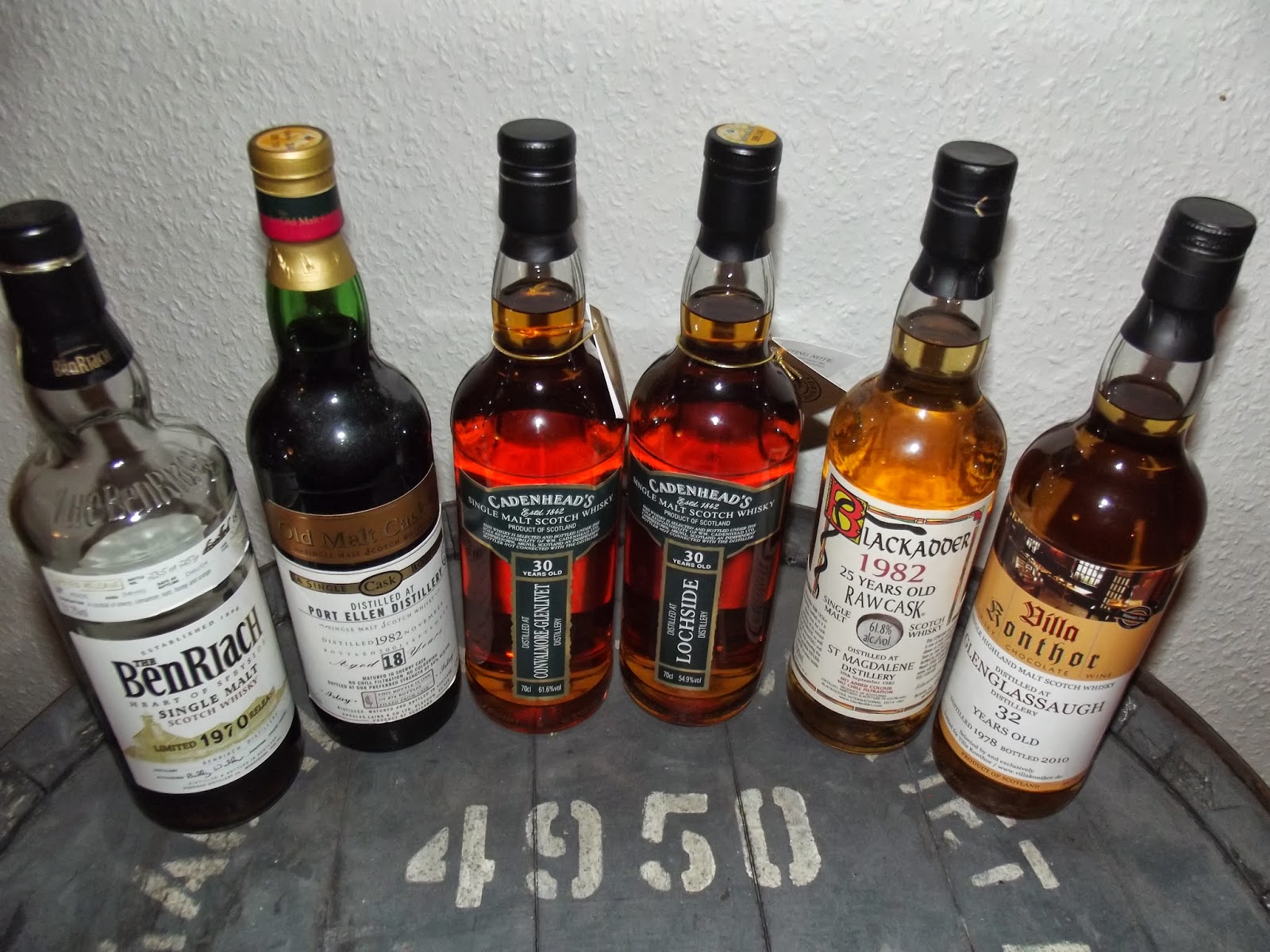
If you think Old Benriach, Port Ellen, Convalmore, Lochside, St. Magdelene and Old Glenglassaugh should have been on the list, I can't really disagree

Should this rare rye have been on the list. I think so

You don't have to go way back in time to find spectular AND affordable whisky.
SMWS 35.71 "like a hug from your mom", released 2012

Benromach 55yo.
I wish I had a bottle
(Photo stolen from TWE)

Martin Mills. Best bourbon I ever tasted. Who wants to sell me a bottle ?

Next list will be: Things to do in Edinburgh, especially  if you like whisky!


Sunday, April 22, 2012

Pappy van Winkle family Reserve 20 years old

Pappy van Winkle family Reserve 20 years old 45.2%


Pappy van Winkle


This whiskey is made at the legendary Stitzel-Weller distillery in Louisville, Kentucky. Stitzel-Weller closed in 1992 and has among bourbon drinkers reached the same mythical status as Brora and Port Ellen has for scotch drinkers.

Pappy van Winkle worked for a wholesale company named W.L Weller and Sons in the beginning of last century. He eventually bought it with a partner, and they also purchased the A. Ph. Stitzel Distillery , with brands like W.L Weller, Old Fitzgerald and others. In 1935 they opened a new distillery and named it Stitzel-Weller.

Stitzel-Weller was sold (to what is now Diageo) in 1992, Weller brands was sold to Buffalo Trace, while Old Fitzgerald followed the distillery. The distillery was closed as Diageo moved all their production to Bernheim. Bernheim was sold to Heaven Hill in 1999 and Old Fitzgerald is today a Heaven Hill brand. The Weller brands is owned by Buffalo Trace.

Traditionally, bourbon was (and is) made from corn, rye and barley, but Weller is known for being a wheated bourbon, made from corn, wheat and barley. This gives a softer, smoother, no rye spice, bourbon, very different from other bourbons.

Originally van Winkle whiskies were sourced from old Stitzel Weller stock, but production has moved to Buffalo Trace. Today, both Buffalo Trace and van Winkle is owned by the Sazerac Company. The van Winkle company is still run by 3rd and 4th generation van Winkle. Stitzel-Weller closed in 1992, it only takes a bit of math to figure out if van Winkle whiskies are from Buffalo Trace or Stiitzel-Weller. 20yo released in 2012 should still be from Stitzel-Weller stock as far as rumours goes.

(An exception to this is the van Winkle rye which was sourced from other distilleries, at least originally)

Nose : oranges cakes, delicate wood
Palate : Bitter oranges, nutty, creamy, with the wood not being overpowering at all. This is smooth, soft and delicate. Very drinkable, the is absolutely no need for adding water
Finish : Medium intensity, but long, very very long. The orangewood lingers forever. Fantastic

This is just not like any other bourbon I have tried. So delicate and subtle, and the first bourbon where I get nutty flavours.

This is one of those whiskies that puts a quiet happy smile on your face

So should we be worried that future bottlings of this will be from a different distillery. Yes and No. It will most likely not be same. Time will tell. But if you have tasted 12yo Old Rip van Winkle and BTAC's William Larue Weller, you know that these whiskies are also great.

As a whisky entusiast I am only excited to see what kind of Pappy 20's the future will give us. Just to be safe I have stocked an extra bottle of this

Rating 92


I reviewed PvW 15 last year here : http://danishwhiskyblog.blogspot.com/2011/07/high-west-bourye-and-pappy-van-winkle.html

Sunday, July 31, 2011

High West Bourye and Pappy van Winkle 15

High West is a new distillery in Park City, Utah.

So far they have released "only" unaged stuff, their silver oat, silver barley and vodka.

But they also bottled a range of ryes and bourbons, sourced at different distilelleries

This is the third High West I review, the other two can be found here :

http://danishwhiskyblog.blogspot.com/2010/08/3-ryes-and-bourbon.html

1. High West Bourye 46%


This is a blend of bourbon and rye whiskey. As far as I know this is a blend of 10yo four roses (their 20% rye mashbill), 12yo LDI (95% rye and 5% barley) and 16yo Barton (53% rye, 37% corn and 10% barley)

Nose : Treesap, spice, sweet wood, delicious rye, one of those whiskies you just want to keep on nosing

Palate : Sweetness, quite woody, but bourbon and ryes do appear woody to me as I started out as a single malt drinker. There's a reallly good balance between the wood, vanilla and spicy rye. 95% ryes can be somehow synthetic and one-sided, but the flavours are really well blendend together here

Finish : medium-long

Rating 90

Comment's : This whiskey isn't a traditional blend, but being vatted together of casks from three different distilleries it actually is. American and scottish blends are used to describe different kind of products.
But this IS blended together really good. My favourite High West so far!

2. Pappy van Winkle 15yo 53.5%


Nose: Wood, solvent, vanilla, cinnamon, cardamom

Palate: Intensen: Very woody, creamy vanilla, tobacco, liqorise

Finish : medium-long

Comment : This is a wheated bourbon. If you like woody tastes this is for you

Rating 85